Start with what you have
A sketch is a place to explore an idea, not a test of artistic ability. You can begin with a pencil, a few sheets of paper, and an ordinary object to look at. If you are building new routines after military service, sketching can be a hobby that needs little preparation and can fit into a short break. There is no requirement to draw every day or turn it into a project.
An inexpensive notebook is useful because it keeps your attempts together, but loose paper works just as well. A standard writing pencil is enough for the first exercises. An eraser is optional: it can help you adjust a drawing, but leaving early lines visible can show you how you worked something out. Choose a comfortable place where you can set down an object and see it clearly. Good lighting makes its edges and shadows easier to notice.
Warm up with lines and shapes
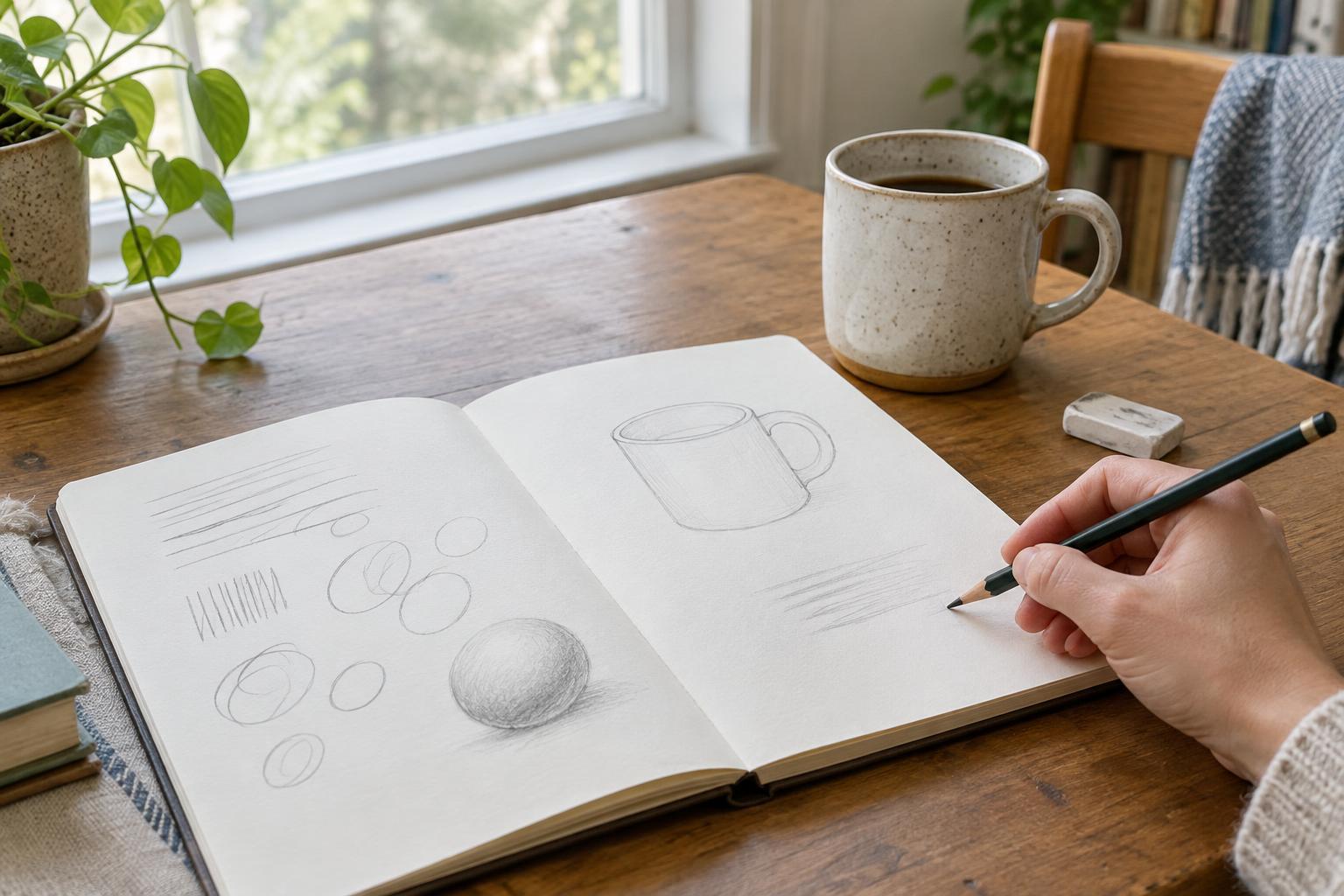
Before drawing an object, fill part of a page with straight lines, curved lines, and loose circles. Try making several lines slowly, then several more with a lighter, quicker motion. You are learning what your hand does, not trying to make every mark identical. If a line goes somewhere unexpected, draw another beside it rather than starting the page over.
Next, draw a row of simple shapes: squares, rectangles, ovals, and triangles. Make some large and some small. Look at the spaces between them as well as the shapes themselves. Then place two shapes together, such as an oval above a narrow rectangle. Many familiar objects can be approached as combinations of these basic forms. A mug, for example, can begin as an oval opening, a rounded body, and a curved handle.
Practice looking before correcting
Pick one everyday item with a clear outline, such as a cup, a shoe, or a set of keys. Set it in front of you and spend a moment noticing its widest and narrowest parts. Where does it sit on the page? Is it taller than it is wide? Make a light drawing of its overall shape before adding small details. This gives you something to adjust without becoming attached to one tiny feature.
Try a second drawing of the same item without moving it. This time, compare the parts with one another: where the handle joins the cup, how far a shoelace extends, or how the keys overlap. You do not have to measure precisely. You can pause, look back at the object, and change your next line. Drawing from observation is partly a practice of checking what is there instead of relying only on what you expect it to look like.
Add light and shadow simply
Once an outline feels familiar, notice where light falls on the object. Find one area that looks light, one that looks darker, and one that falls between them. Leave the lightest area close to the color of the paper. For a middle tone, make a group of light pencil strokes. For a darker tone, add another layer of strokes. Pressing gently at first gives you room to build up the shade.
You can practice this without drawing an object at all. Make three small boxes and shade them light, medium, and dark. Then return to your cup or shoe and use those three tones to suggest its form. Shadows do not need perfectly smooth edges. Look for the larger patches first; the details can wait.
Keep the hobby easy to return to
A manageable first session might include a page of lines and shapes followed by one drawing of an object. On another day, draw the same object from a different angle or choose something from a walk, a kitchen shelf, or a desk. Repeating a subject lets you notice changes in how you observe it. Dating a page can help you find earlier attempts later, but there is no need to score your progress.
If you get stuck, make the task smaller: draw only the outline, spend a few minutes on shading, or sketch one part of an object. Keep your materials somewhere easy to reach if you want sketching to become part of your routine. The goal is not a perfect page. It is to give yourself a simple way to look closely, try an idea, and come back when you feel like drawing again.